Ideas by genre Ideas Some effort290 min
Techno music video ideas: six for club tracks
Six concepts for techno and club tracks, from loops to silhouettes, with shot timings, cut points on the kick and safe limits for strobing light.
 Frame the Song Editors 5 min read
What do you need before you start?
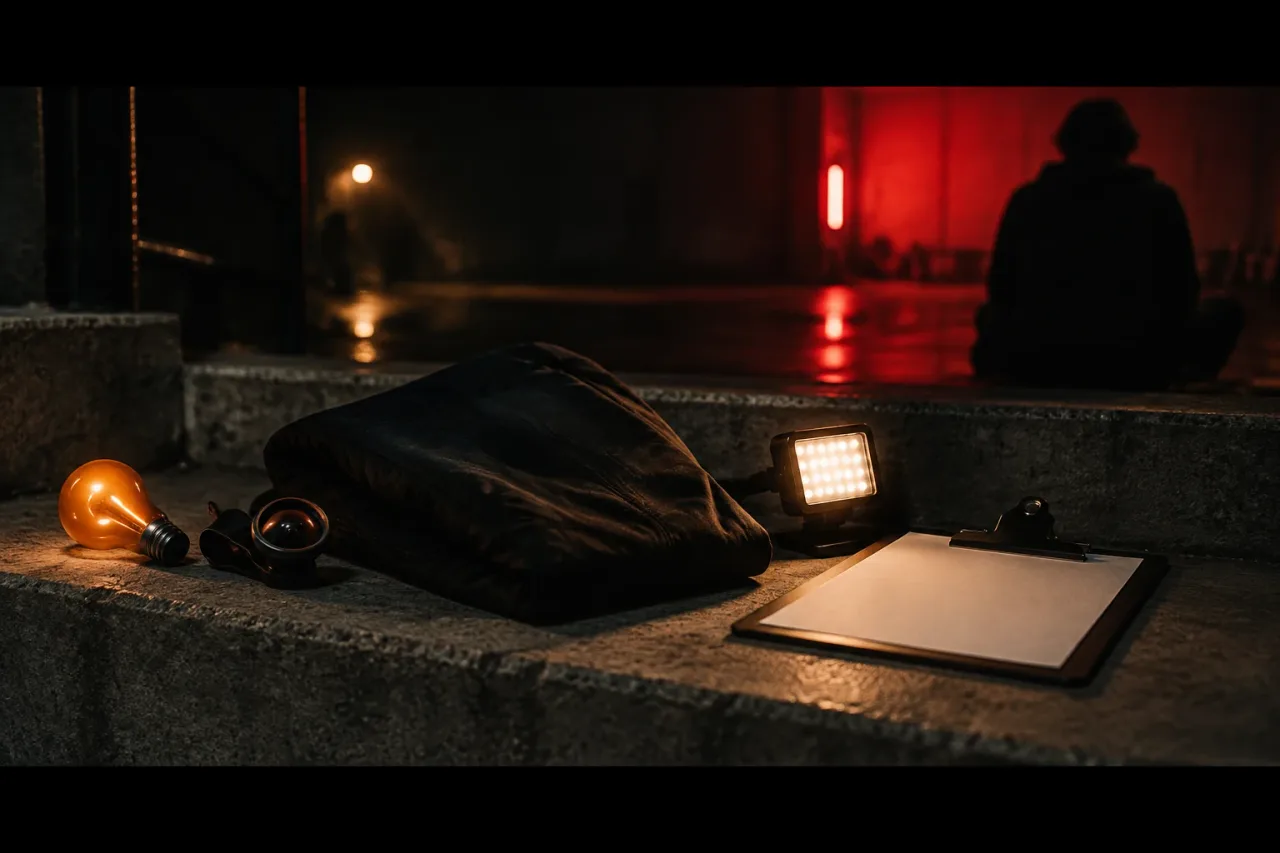
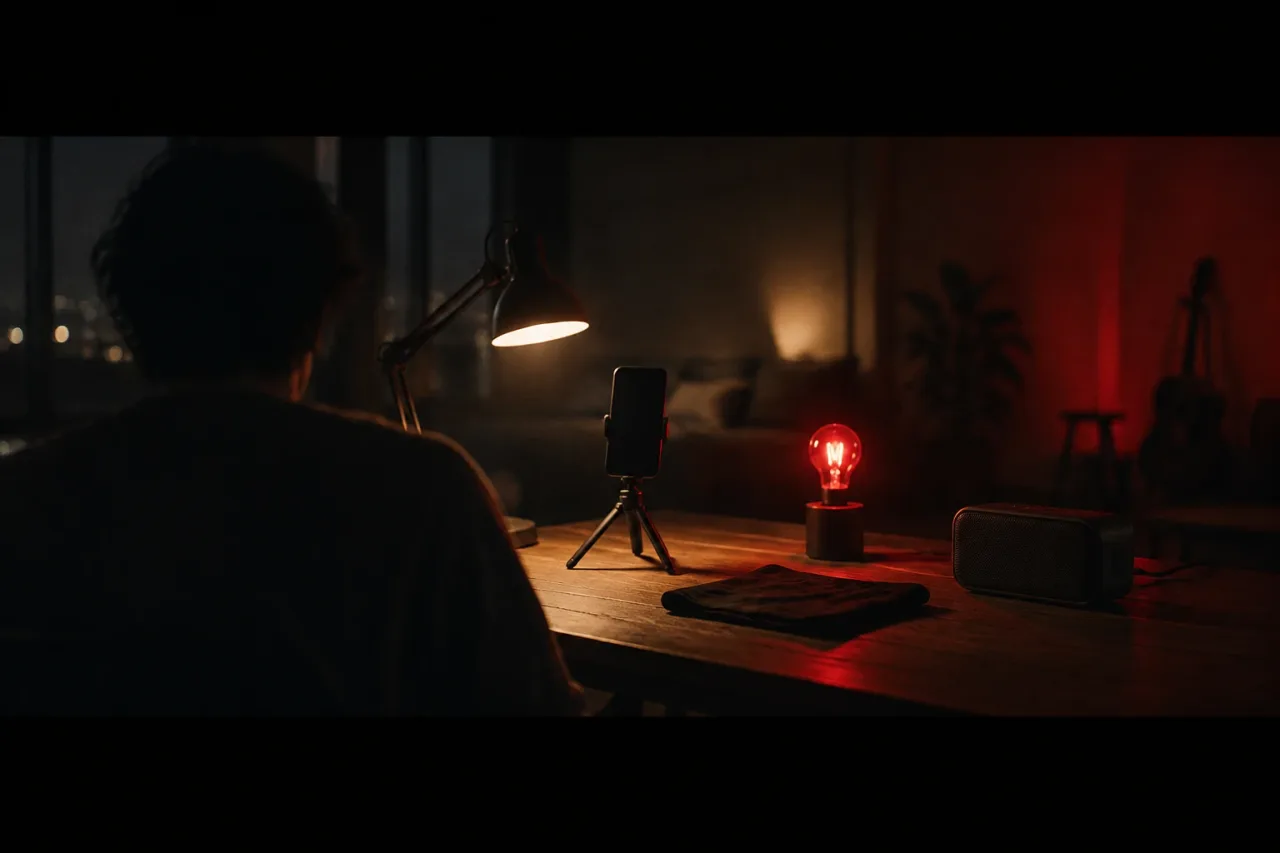
You need a phone or small camera, a tripod, one light, a dark backdrop and permission to use everything that appears on screen. Techno rewards a small, controlled set, so the kit list is short.
- A phone or camera on a tripod, set to 25 fps.
- One light: an LED panel at 5600K, or a bare bulb lamp near 3200K.
- A black sheet or dark wall, roughly 2 by 3 metres.
- A red bulb or red gel for the colour idea.
- A speaker for playing the track on set.
- Dancers who have agreed to be filmed.
Use only a track you own or have cleared, and ask the owner before filming in any venue or private space. This is not legal advice.
What order do you work in?
Work in six steps, in this order, and allow about 290 minutes in all.
- Pick one concept from the six below and write it as one sentence (10 minutes).
- Mark the track in 8 bar blocks on paper (20 minutes).
- Write a shot list of 8 to 12 shots, each with a bar count (20 minutes).
- Shoot one setup at a time at 25 fps (90 minutes).
- Cut the shots to the kick (120 minutes).
- Grade the whole video as one look (30 minutes).
Shoot each setup for a full 32 bars. At 128 bpm that is one minute, which leaves spare picture on both sides of every cut.
Where do the cuts go?
Cut on the kick, and change the picture on the first kick of an 8 or 16 bar phrase. At 128 bpm one bar lasts about 1.9 seconds, so 8 bars is 15 seconds and 16 bars is 30 seconds.
Inside a phrase, a cut every four beats gives a shot of about 1.9 seconds, which feels driven but readable. During a long build, hold one shot for the whole 8 bars. The hold is what makes the drop land when the picture finally changes.
A cut that lands a few frames after the kick feels like a mistake. Cut on it, or a frame early. DaVinci Resolve is free and handles this kind of cutting well.
How do loops and a changing locked-off room work?
Both ideas use a camera that never moves, and the change happens in front of it.
For repetition, film one 4 bar action, about 7.5 seconds at 128 bpm. A dancer steps through a doorway, turns and steps back. Loop it eight times and change one thing each pass: a jacket, the light colour, the number of people in frame.
For the locked-off room, set the camera at chest height on a 35mm equivalent lens. Lock the exposure and white balance. Over each 16 bar block, change the room: swap a 3200K bulb for a cold one, remove a chair, add a second dancer. The viewer should only notice the room has changed after it already has.
How do you shoot monochrome with one red, and silhouettes?
Grade everything to black and white, then keep one red object in colour. A coat, a door or a single bulb all work. Hold the red steady in frame and keep it small, because a large red surface will tire the eye and can become a flash if it flickers.
For silhouettes, put the dancers about 3 metres in front of a pale or coloured wall. Light the wall, not the dancers, and expose for the wall so the bodies fall to black. Frame at 2.39:1 and keep the dancers’ edges clear of each other.
Shoot the silhouettes in 16 bar takes. The shapes carry the rhythm, so the cut can stay slow.
How do you make a visualizer for a club track?
Choose one shape, a palette of two colours and one thing that reacts to the kick. A visualizer fails when everything moves at once.
Neural Frames is built for audio-reactive work, with effects that pulse with the music. It runs on the web and exports at 25 fps, so match your other shots to 25. Its pricing page states no free plan or trial.
Plan the visualizer in 16 bar sections. Let the first section stay quiet, add a second movement at the next phrase, and keep the loudest picture for the drop. You can also cut it against your own footage, using the visualizer as the drop and the silhouettes as the verse.
How do you use strobing light safely?
Keep flashes to no more than three per second, and never flash a full-screen red. Flashing images can trigger seizures in people with photosensitive epilepsy, so treat this as a hard limit, not a taste choice. This is not medical advice.
At 128 bpm a flash on every kick is about 2.1 flashes a second. A flash on every eighth note is over four, which is too fast. Flash on the kick, never on the hi-hat.
Build the strobe in the edit by cutting between a dark frame and a lit one, so nobody on set sits in a real strobe. Keep the lit frame dim, avoid stacking two strobes, and put a short warning card at the start of the video.
What goes wrong, and how do you make it easier next time?
Most problems come from too many ideas, cuts off the beat and flat lighting. Pick one concept and finish it before you borrow from another.
If your energy drops after 90 minutes of shooting, stop and cut your list to six shots. One strong setup shot for a full 32 bars will carry more than twelve rushed ones. Light one side of the face or wall only, and let the rest fall dark.
To make the next one easier, save your 128 bpm bar-count sheet, keep the dark corner and the sheet set up, and reuse the same shot list layout. The second video usually takes about an hour less to plan.
Frequently asked questions
What is the easiest techno video idea to shoot alone?
A repetition loop. Film one 4 bar action on a locked-off camera, then repeat it and change one detail each time. You need one light and one dark wall.
How fast can a strobe flash in a music video?
Keep it to no more than three flashes per second, and avoid full-screen red flashes. Flashing images can trigger seizures in people with photosensitive epilepsy. If you are unsure, slow the flashes down and add a warning card.
How many bars should each shot last in a techno video?
Change the picture every 8 or 16 bars, and cut on the kick. At 128 bpm that is 15 or 30 seconds. Inside a phrase, a shot of about 1.9 seconds, one bar, feels driven.
Can I make an audio-reactive visualizer for a club track?
Yes. Neural Frames makes audio-reactive effects that pulse with the music, and it exports at 25 fps. Its pricing page does not state a free plan or trial, so check the cost before you plan around it.
Do I need dancers to make a club video?
No. A locked-off room that changes light colour and furniture every 16 bars works with nobody in frame. If you do film dancers, get their agreement first.