Technique Breakdowns Some effort150 min
How choreographed one-take videos work, and how to stage one
How choreographed one-take videos work, and a 150-minute plan to stage a 38-second version with four friends, one phone and a few props.
 Frame the Song Editors 4 min read
How does a choreographed one-take video work?
A choreographed one-take video keeps the camera still, or nearly, and lets the people and props do the editing. Every reveal, entrance and change of scene happens in front of the lens, timed to a beat, so the routine is the cut. OK Go are widely known for one-take choreographed videos. The same idea shrinks to a living room. Take a 16-bar section at 100 bpm: it lasts about 38 seconds. Split it into eight moves of two bars, 4.8 seconds each. Each move has one job, such as a lamp coming on, a chair sliding in or a sheet pulled across the frame. Nothing can be fixed afterwards, so a plain move on the beat looks better than an ambitious one that lands late. The trade word for the result is an oner.
What do you need before you start?
You need four people, one phone and about 150 minutes. Person 1 is the singer and persons 2, 3 and 4 are the crew in shot. Gather this kit first:
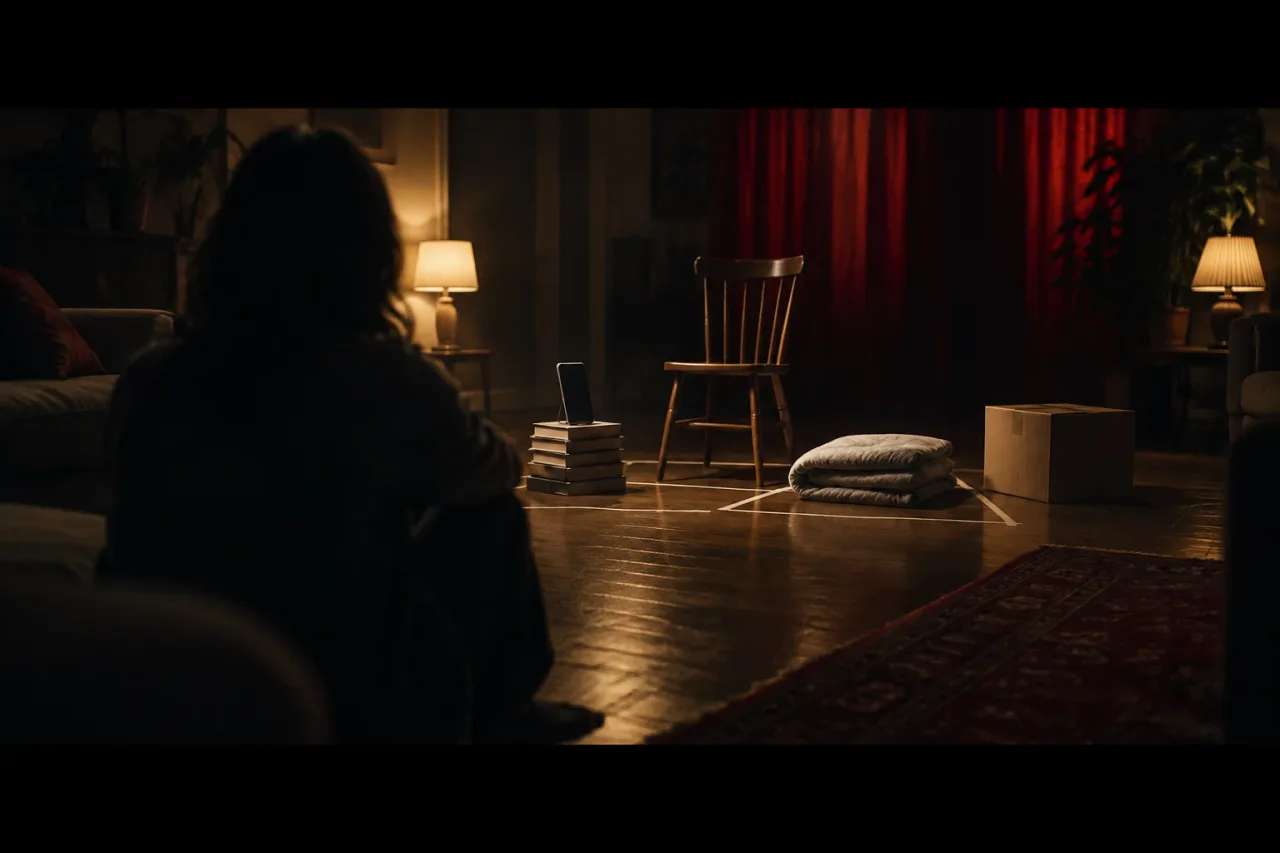
- A phone on a tripod or a stack of books at chest height, filming 16:9 at 25 fps.
- A speaker loud enough to carry the track at full volume for playback, so the singer can mime to it.
- Masking tape for floor marks.
- Two lamps with matching warm bulbs.
- Three props that move: a chair, a bedsheet and a cardboard box.
Use a song you wrote or have written permission to use, and ask everyone in shot if they are happy to be filmed. Keep every move at floor level. Nobody stands on furniture.
How do you plan the routine?
Write the routine as eight two-bar moves on one sheet, with a person and an action against each. Here is a version at 100 bpm:
- 0 to 4.8 s: person 1 sings from the centre mark, one lamp on.
- 4.8 to 9.6 s: person 2 slides the chair to the mark.
- 9.6 to 14.4 s: person 1 sits. Person 3 switches on the second lamp on the downbeat.
- 14.4 to 19.2 s: persons 2 and 3 hold the sheet across the frame.
- 19.2 to 24 s: behind the sheet, person 1 moves to the left mark and person 4 takes the chair away.
- 24 to 28.8 s: the sheet drops. Person 4 hands the box to person 1.
- 28.8 to 33.6 s: the box passes hand to hand along the line.
- 33.6 to 38.4 s: persons 2 and 3 switch the lamps off. The singer holds the last light.
In what order do you rehearse and shoot?
Work in six steps and film last. The whole run takes about 150 minutes.
- Tape marks for the singer, the chair and the sheet holders, and fix the camera (20 minutes).
- Walk the routine in silence, counting bars aloud (25 minutes).
- Walk it with the track at full speed, camera off (35 minutes).
- Film one test take, then check the frame, the lamps and the sound (10 minutes).
- Film up to 10 takes, with a short rest between each (45 minutes).
- Watch the takes back and pick one (15 minutes).
Step 3 takes the most time, and it should. A routine that works with the music on, at speed, will survive the camera.
Where do you put the camera and the light?
Put the phone at chest height, locked off, with a wide frame and two matching lamps as the only light. Switch off the overhead light and close the curtains, so daylight at around 5600K does not fight the warm bulbs. Pick one wall colour behind the action and keep the props to a single second colour. A dark green wall with a cream sheet reads clearly on a phone. Leave a hand’s width of air above the heads so a raised sheet stays in frame. Lamps visible in shot are practical light, and each one gives you a warm pool to build a move around. A slow push-in suits a ballad, but it needs a fifth person to pull the tripod on a towel across the floor, so keep the first version locked off.
What do you do when takes keep failing?
Drop the hardest move and rehearse the routine in two halves. Most failures come from one move. Split at bar 8, which is 19.2 seconds in, run each half three times, then join them. If take 10 arrives and nothing is clean, choose the take where the singer sold the song, even if the chair landed a beat late. Rest for five minutes after take 5. Check these before you blame anyone:
- A move starts between beats instead of on one.
- A prop sits where nobody can reach it.
- The tripod has been bumped and the marks no longer match the frame.
- The two bulbs differ, so the colour shifts across the room.
- The singer stops singing to watch the crew.
How do you make the next one easier?
Write the run sheet in a tool and film a phone rehearsal before the real takes. Put the eight moves into a shot list. StudioBinder has a free plan with up to 10 shots in a shot list, which fits eight moves, and a sheet of paper works as well. Film step 3 on the phone from the real camera spot and watch it back to catch a blocked frame. Label each prop and mark with its move number. For the next version, add a ninth move at a section change in the song, or stretch to 32 bars, which runs about 77 seconds at 100 bpm. Keep the same four people. They already know the count.
Frequently asked questions
Does a one-take music video have to be a single take?
In this guide, yes. The camera rolls once from the first bar to the last. Hiding a cut behind a passing sheet or a dark doorway is a separate technique, and you can use it later to join two takes.
How long should a living room one-take routine be?
Sixteen bars is a good first target. That is about 38 seconds at 100 bpm and 32 seconds at 120 bpm. Divide the bars into two-bar moves so every move lasts a few seconds.
Can I do this with fewer than four people?
Yes. With two people, leave the second lamp on from the start and drop the sheet move. The singer and one helper can still do the chair, the box and the lamps going off at the end.
Do I need a gimbal or a slider?
No. A phone on a tripod or a stack of books at chest height is enough for a locked-off version. A slow move needs a fifth person pulling a tripod on a towel, so try it only after the routine works.
Can I use a song I did not write?
Only if you have permission from whoever owns it, and the same goes for anyone who appears in shot. Get that agreement in writing before you film. This is not legal advice.