Treatments Craft Some effort90 min
How to write a music video treatment on one page
A one-page treatment template with eight fixed headings, a writing order with times, and a filled-in example you can copy for your own song.
 Frame the Song Editors 4 min read
What a treatment is and why one page wins
A treatment is a one-page pitch for a single idea, written so a producer, a label contact or a friend with a camera can picture the video in two minutes. One page beats ten. A long document gives the reader ten places to disagree with you, and it buries the one image that was always going to sell the idea. A page forces you to choose. A treatment can have a moodboard behind it, but the page stays the pitch. Write it before you book anyone and before you open a shot list. The schedule, the shot list and the grade all get easier once the idea is decided.
What you need before you start
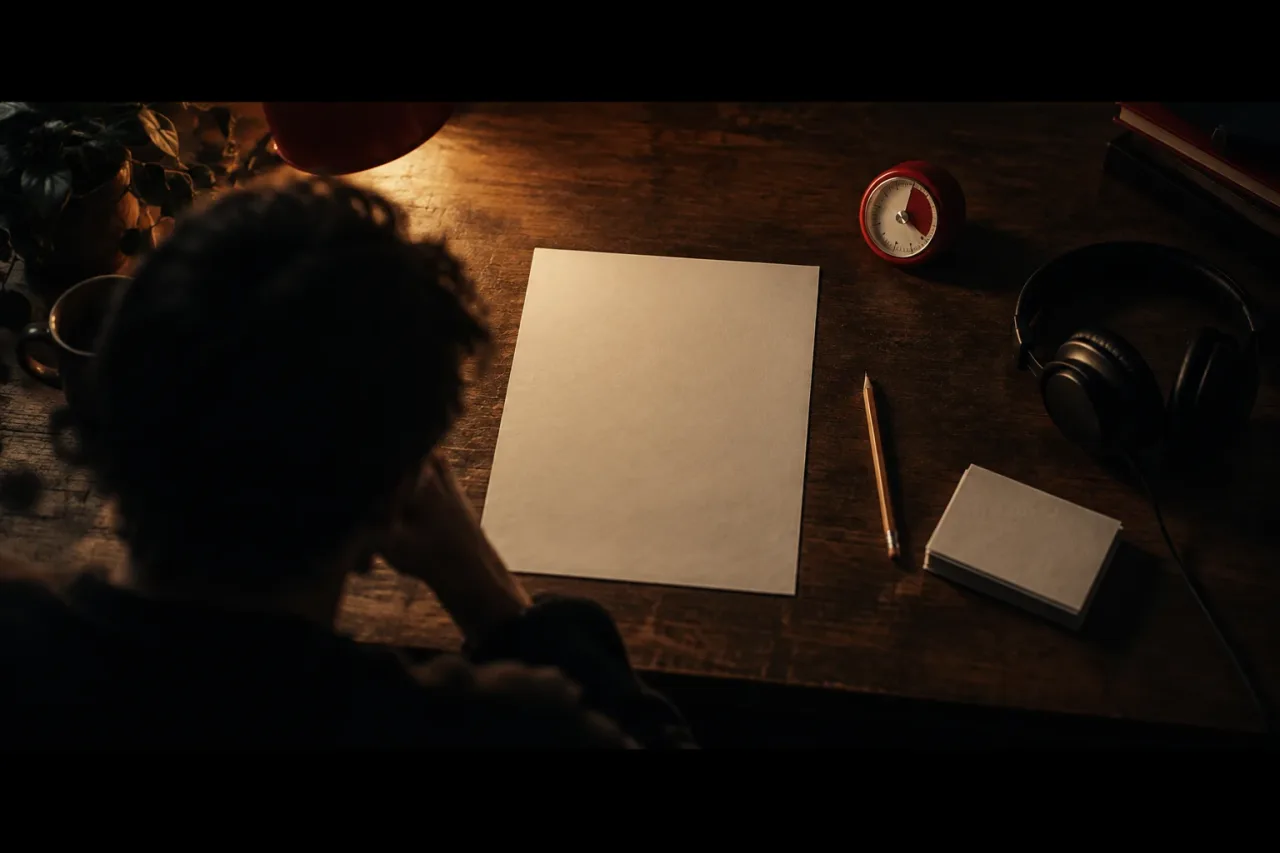
You need the finished song, headphones, a timer and one blank page, plus 90 minutes without interruption.
- The final mix, or a rough mix with the real structure
- Headphones, so you hear the drums and the breaths
- A blank A4 page or document, one side only
- A pen for the first listen
- Up to ten reference images or clips, kept to one side
Do not build a moodboard first. If you want somewhere to collect images, Milanote boards mix notes, images, video, sketches and links, and the free plan has no time limit. The board sits behind the page. The page is what you send.
The template, heading by heading
Use eight fixed headings, in this order, and keep each to a few lines.
- Title and song. Working title, song name, length, tempo.
- Logline. One sentence, under 25 words, saying who does what and where.
- The one image. The frame people will remember, in two sentences.
- World. Location, era, wardrobe.
- Look. Colour palette, light, lens feel, aspect ratio (9:16, 16:9 or 2.39:1).
- Structure. Intro, verse 1, chorus, verse 2, bridge, last chorus, outro, with what happens in each and the time it starts.
- References. Described in words, such as a held shot or a colour of wall.
- Practical notes. Days, locations, cast, rights.
The headings stay the same for every song. Only the answers change.
The writing order, with times
Write in this order and the whole page takes about 90 minutes. The order differs from the page order because the image decides everything else.
- Listen three times with a pen, 15 minutes. Mark where each section starts.
- Find the one image, 10 minutes.
- Write the logline, 5 minutes.
- Fill in world, 10 minutes.
- Fill in look, 10 minutes.
- Map the structure, 25 minutes. Give each section one or two sentences and change one thing at a time. Save the biggest change for a chorus.
- Describe references in words, 5 minutes.
- Write practical notes, 8 minutes.
- Add the title and song line, then read the page aloud, 2 minutes. Cut any line that does not serve the image.
A filled-in example for an invented song
Here is a full page for Low Tide Radio, an invented 3:40 ballad at 72 bpm.
- Title and song. Low Tide Radio, 3:40, 72 bpm.
- Logline. A night cleaner sings the whole song to an empty office, and the lights come on one bank at a time.
- The one image. She sits cross-legged on a desk in a pool of lamp light while the floor behind her fills with cold white.
- World. Present-day open-plan office, grey tabard, a cleaning trolley.
- Look. 3200K desk lamp against 4300K ceiling tubes, 2.39:1, 25 fps, a long lens feel.
- Structure. Intro, a torch beam on a dark floor. Verse 1, one slow push-in of 20 seconds. Chorus, the first bank of tubes flickers on. Verse 2, she walks the aisles. Bridge, every light cuts out. Last chorus, all banks on and a pull-back. Outro, one lamp left.
- References. The stillness of a corridor on a security camera.
- Practical notes. One night, one office, one performer, written permission from the building manager.
Common mistakes
The commonest mistake is putting two ideas on one page. Pick the stronger one and cut the other.
- A look section that says cinematic. Write 3200K, 2.39:1 and a long lens instead, so someone can light it.
- A structure that changes everything at every section. The chorus will have nothing left to give.
- Locations or people with no permission. Use only songs, faces, footage and places you own or have permission to use. This is not legal advice. Archive footage and anyone else’s likeness need clearing first.
- Dangerous shots. Keep anything dangerous out of the page and write the safe version of the shot.
A reader should be able to shoot from your page with one friend and one light.
When you stall, and how to make it easier next time
If you stall, go back to the one image and rewrite it in two sentences. If your energy runs out around minute 60, stop after the structure, leave the page overnight and finish references and practical notes the next day. The structure is the part that matters.
Next time, save the eight headings as a blank page and note the section timings while you listen. Once the idea is agreed, turn the structure into a shot list. StudioBinder has a free plan with one project and up to 10 shots in a shot list, which fits a single song. Keep the one-page treatment attached, so the shot list never drifts from the image.
Frequently asked questions
How long should a music video treatment be?
One page. That is roughly 300 to 500 words, enough for eight short headings and a structure mapped to the song. If it runs longer, you probably have more than one idea in it.
What goes in a music video treatment?
Title and song, a one-sentence logline, the one image people will remember, the world, the look, a structure mapped to the song, references described in words, and practical notes. The practical notes cover days, locations, cast and rights.
Should I write the treatment before the shot list?
Yes. The treatment decides the idea and the shot list breaks it into frames. Writing them the other way round gives you a list of shots with nothing holding them together.
Do I need a treatment if I am shooting the video myself?
A page still helps, because it tells you what to shoot on the day and what to leave out. It also gives anyone you ask for help, such as a friend with a light, one thing to read.
Should I use pictures in a treatment?
Describe references in words on the page, such as a held close-up or a pale green wall. Keep the pictures on a separate board behind it, so the page still reads as one clear idea.