Concepts Craft Big effort240 min
How to plan and shoot a one-take music video
Plan a one-take music video from bar count to final take: route, rehearsal, hidden cuts, practical lights, locked exposure and playback.
 Frame the Song Editors 4 min read
What you need before you start
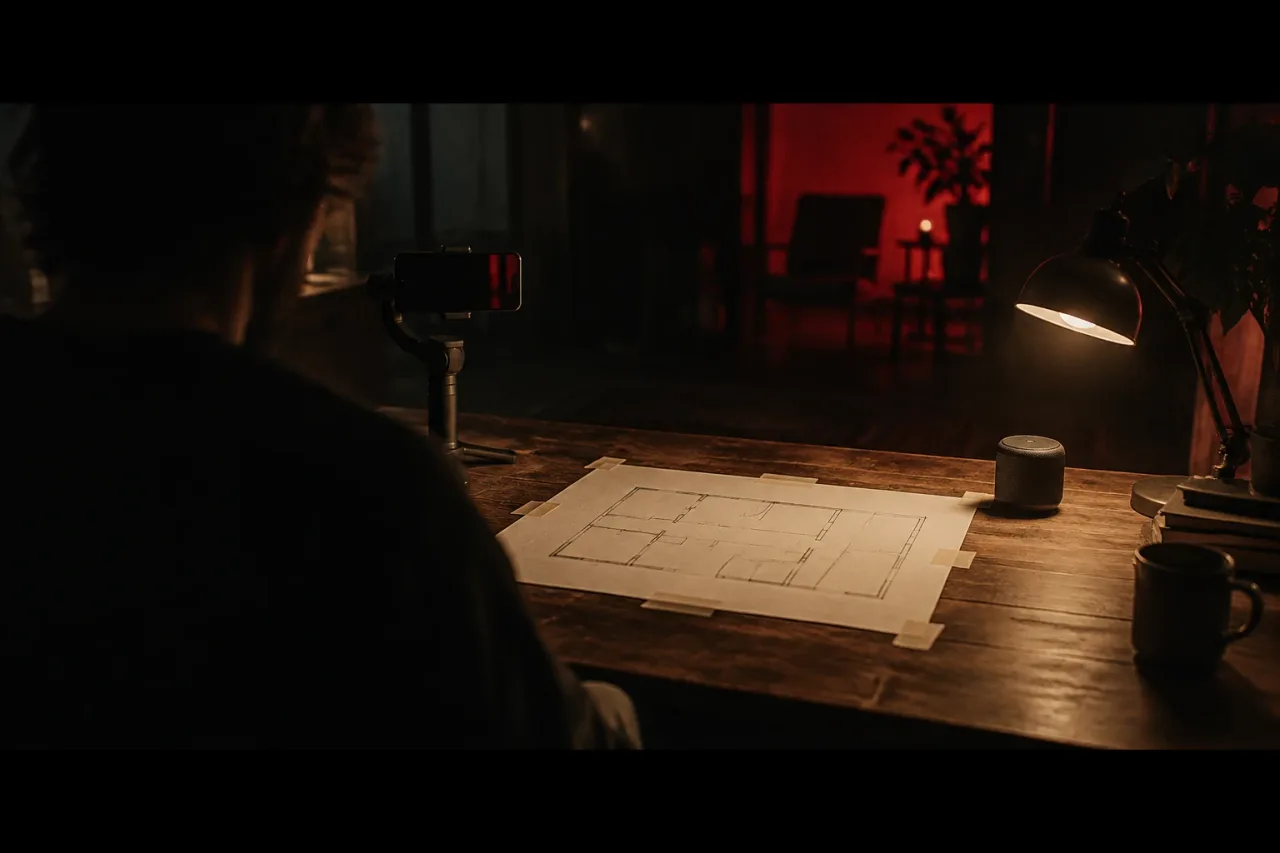
You need a camera you can hold steady for the whole song, a speaker, six practical lamps and permission to film in the space. Gather them before you plan a single move.
- A camera on a gimbal, or a phone in a grip, set to 25 fps
- A speaker loud enough to hear over footsteps
- Six lamps with 3200K bulbs
- A printed floor plan and a pencil
- One helper to act as spotter
Film only in places you own or have permission to use, and only with people who agree to be on camera. Check that you have the rights to the song too. This is not legal advice.
Map the route to the bars
Divide the song into bars, then give each block of bars a place in the room. A three-minute song at 120 BPM has 90 bars, and each bar lasts two seconds. Split it into six zones of about 15 bars, roughly 30 seconds each. Draw the floor plan and number the zones along the path. Put the verse in a tight corridor, the pre-chorus at a doorway and the chorus in the biggest room. Let each change of space land on the first beat of a section, never mid-bar. If your song has a different tempo, divide its length in seconds by the length of one bar and do the same sums.
Rehearse and block the walk
Rehearse three times, 20 minutes each, with the song playing, and carry the camera on the last run. Walk at normal walking pace. Never run, and never walk backwards unless your spotter is behind you. Stick small tape marks on the floor where the lens will not see them, one per zone. Write the bar number beside each mark, so the singer knows they reach zone three at bar 31. Ask the operator to stay a step ahead of the singer or a step behind, and keep that distance. A slow push-in at the chorus beats a quick orbit, because the singer’s face stays readable for the whole line.
Hide a cut where the route needs one
Hide a cut by ending one take on something that fills the frame and starting the next from the same thing. Two joins is a sensible limit for a first attempt. Three reliable ways to do it:
- Whip pan: swing the camera about 90 degrees in under half a second and begin the next take mid-blur.
- Dark doorway: walk through a door at the moment the frame goes near black, for 1 to 2 seconds.
- Shoulder wipe: a helper’s coat crosses the lens.
Place the join on the first beat of a bar, and match the singer’s position and the lamp light on both sides. A strict oner has no joins at all, so decide before rehearsal which one you are making.
Light the whole path with practicals
Light the whole path with practical light, meaning lamps the camera is allowed to see. Put one lamp in each zone, six in all, about 1.5 to 2 metres high and behind or beside the singer’s route so they rim the face. Use bulbs of one colour temperature, 3200K tungsten, so the walls stay one warm colour. Close the curtains, because 5600K daylight next to tungsten makes one room blue and the next orange. If a window must stay open, shoot at dusk. Tape every cable flat. Then walk the full route once with only the lamps on and look for dark patches on the monitor.
Lock the camera and set up playback
Switch exposure, white balance and focus to manual before the first take. Use 25 fps, a 1/50 shutter and a white balance of 3200K to match the bulbs. Set exposure in the brightest zone, then check the darkest zone is still readable. On a phone, hold your finger on the screen to lock exposure and focus. A wide lens at a small aperture keeps focus steady as you move. For playback, put the speaker at the start and a second one halfway along if the route is long. Record the song’s audio on the camera as a guide, so you can line it up with the studio track in the edit.
The order of work and what to do when a take fails
Work in this order, which takes about 240 minutes in total and sits best across two days.
- Map the bars to the floor plan, 30 minutes.
- Rehearse three times, 20 minutes each, carrying the camera on the last run.
- Light the path with 3200K practicals, 45 minutes.
- Lock 25 fps, 1/50, 3200K and focus, 15 minutes.
- Shoot up to 10 takes, 90 minutes including rests.
If a take breaks at the same bar twice, change that move rather than repeat it. Rest five minutes between takes, and reset the lamps and speaker each time. When your energy drops, stop after take 10 and choose from what you have.
Common mistakes and an easier next time
The commonest mistakes are a route longer than the song, auto exposure and mixed bulbs. Fix them in that order, because a route that runs out of bars cannot be saved in the edit. Keep a log for each take with its number and the bar where it broke, so patterns show up. Next time, shoot a single chorus of about 30 seconds as a oner first. That needs one lamp, one zone and one hour of rehearsal, and it teaches you how your camera moves with the singer before you commit to a whole song.
Frequently asked questions
How long should a one-take music video be?
As long as the song. A three-minute track at 120 BPM is 90 bars, or 180 seconds, so the route has to fill that exactly. If that feels like too much, shoot one 30-second chorus first.
Can I shoot a one-take music video on a phone?
Yes. Set it to 25 fps, lock exposure and focus by holding on the screen, and use a grip or gimbal. A phone is light enough to carry for three minutes at walking pace.
Is it still a oner if I hide a cut?
Strictly, a oner has no cuts. A version with one or two hidden joins, such as a whip pan or a dark doorway, is a close cousin, so say which one you made.
How many takes will I need?
Plan for up to 10, with five minutes of rest between each. Stop earlier if you get a clean run, and stop at 10 if you do not, then pick the best.
How do I keep a walking shoot safe?
Keep to walking pace, tape cables flat and have a spotter walk behind the operator. Film indoors or in a private space you have permission to use, away from traffic, and skip stairs unless they are lit and clear.